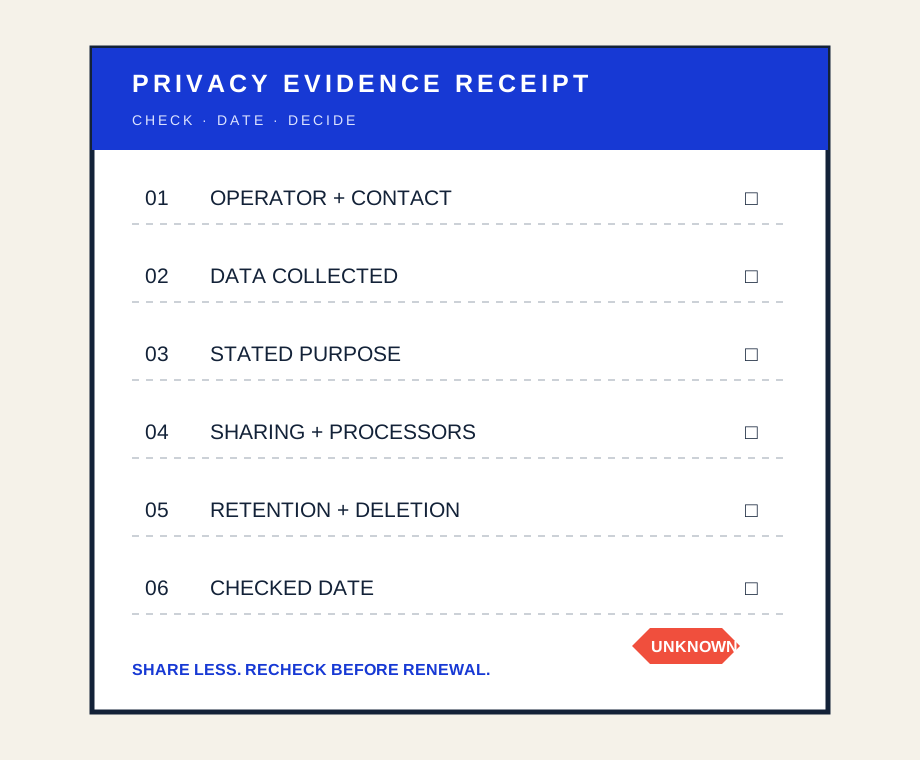
Start with the exact document or control that applies to the account today. Record the operator, date, data category, stated purpose, recipient, retention boundary and available control. If the source does not answer one of those fields, write unknown. The purpose of this page is not to turn a policy into a trust badge. It is to make the next decision smaller, dated and reversible.
Voice can reveal identity, emotion and surroundings. A playful feature does not remove the need for a specific data boundary.
What to inspect before deciding
01recording notice□
02transcription purpose□
03voice model use□
04biometric wording□
05retention period□
06deletion route□
Unknown stays unknown. Recheck before sharing.The six fields below are deliberately narrow. Check them against the current notice, account screen or regulator guidance rather than relying on a search snippet. Save the checked date and the URL because wording, ownership and controls can change.
recording notice
Find the specific wording for recording notice. Separate a vendor statement from an independently verified fact, note any regional condition, and avoid extending the claim beyond the product and date named by the source.
transcription purpose
Find the specific wording for transcription purpose. Separate a vendor statement from an independently verified fact, note any regional condition, and avoid extending the claim beyond the product and date named by the source.
voice model use
Find the specific wording for voice model use. Separate a vendor statement from an independently verified fact, note any regional condition, and avoid extending the claim beyond the product and date named by the source.
biometric wording
Find the specific wording for biometric wording. Separate a vendor statement from an independently verified fact, note any regional condition, and avoid extending the claim beyond the product and date named by the source.
retention period
Find the specific wording for retention period. Separate a vendor statement from an independently verified fact, note any regional condition, and avoid extending the claim beyond the product and date named by the source.
deletion route
Find the specific wording for deletion route. Separate a vendor statement from an independently verified fact, note any regional condition, and avoid extending the claim beyond the product and date named by the source.
How to interpret a complete or incomplete card
A complete field means the source gives a usable answer; it does not mean the answer is favorable. A missing field is a decision constraint. Reduce the data you share, keep a permission off, delay payment, choose a different service or contact the operator through the official route. Do not fill a gap with marketing language from another page.
Compare like with like. A privacy notice, terms page, app permission and deletion control answer different questions. A strong account control cannot repair a vague collection purpose, and an encryption claim cannot explain retention. Keep each piece of evidence in its own column before reaching a conclusion.
Use low-risk fictional examples if a feature needs a prompt. Never upload a real person’s private image, reveal credentials or provoke harmful content merely to see what happens. This guide relies on public evidence and does not claim hands-on access to private account behavior.
What this page cannot promise
- It cannot certify that a provider, conversation or account is private or safe.
- It cannot prove unseen technical behavior from policy wording alone.
- It cannot replace legal advice, regulator guidance or emergency support.
- It does not convert a sponsored link into an endorsement or a product test.
Stop when the operator is unclear, the data requested exceeds the feature’s need, another person’s consent is missing, an adult boundary is ambiguous, or the exit route cannot be found. Preserve only the evidence you need and avoid creating additional sensitive copies.
A practical decision record
- Capture
Save the exact page, checked date and wording that supports the field.
- Classify
Label it vendor statement, account control, regulator guidance or independent standard.
- Constrain
Turn each unknown into a smaller permission, smaller disclosure or delayed purchase.
- Recheck
Review the evidence before sharing more data, renewing or changing the account.
Public evidence used for this question
- UK ICO guidance on AI and data protection
Regulator guidance on transparency, data minimization, fairness, security and individual rights in AI systems.
government regulator · checked September 23, 2026 - OWASP sensitive-information guidance
Security guidance for reducing sensitive-information disclosure and avoiding unnecessary secrets in prompts.
independent standard · checked September 23, 2026 - Candy AI privacy policy
Vendor-stated data collection, purposes, sharing, retention, rights and contact routes.
vendor policy · checked September 23, 2026